How Much Pumpkin Puree to Give a Dog
Wondering how much pumpkin puree to give a dog? Get safe starting doses by size, when pumpkin helps, when it won’t, and when to call your vet.
If you’re wondering how much pumpkin puree to give a dog, the short answer is this, start small and don’t treat it like a cure-all.
For most dogs, plain pumpkin puree is safe in small amounts and can help with mild constipation or mild diarrhea. But too much can make things worse. I’ve seen owners give half a can to a dog with an upset stomach, then end up with a much messier problem a few hours later.
Quick answer: how much pumpkin puree to give a dog
A good starting guide for plain pumpkin puree is:
| Dog size | Starting amount | Max per serving |
|---|---|---|
| Under 10 lb | 1/2 to 1 teaspoon | 1 teaspoon |
| 10 to 20 lb | 1 to 2 teaspoons | 1 tablespoon |
| 20 to 40 lb | 1 tablespoon | 2 tablespoons |
| 40 to 70 lb | 1 to 2 tablespoons | 3 tablespoons |
| Over 70 lb | 2 tablespoons | 4 tablespoons |
You can offer it once or twice a day for 1 to 3 days.
That’s enough for most dogs. More is not better. Pumpkin works because of its fiber and water content, not because it is some kind of magic digestive reset.
If your dog has never had pumpkin before, start at the low end of the range. Watch the next one or two bowel movements before giving more.
What kind of pumpkin is safe for dogs
Use plain canned pumpkin puree or homemade plain pumpkin puree.
Do not use pumpkin pie filling. That stuff often has sugar, spices, and other ingredients your dog does not need. Some flavored products may also contain sweeteners or additives that can upset the gut.
Check the label. You want one ingredient, pumpkin.
Cooked fresh pumpkin is fine too, as long as it is plain. No butter. No salt. No nutmeg. No “just a little” whipped topping.
When pumpkin actually helps
Pumpkin can be useful, but only for a pretty narrow set of problems.
It helps most with mild constipation and mild diarrhea. That’s because the soluble fiber can help soften stool when a dog is constipated, but it can also absorb extra water in the gut when stool is loose. Weirdly, it can help in both directions.
That said, this works for most dogs, not all. Some dogs do great with pumpkin. Some get more gassy. A few get looser stool if you give too much.
Mild constipation
If your dog is passing small, dry stools but still acting normal, eating, drinking, and not straining hard, a little pumpkin may help.
This is the kind of situation where pumpkin makes sense:
- your dog skipped a bowel movement for a day
- stool is dry or harder than usual
- your dog is not vomiting
- your dog still has normal energy
- your dog is not crying, bloated, or repeatedly trying to poop with nothing coming out
If your dog is straining over and over, seems painful, or has a swollen belly, skip the pumpkin and call your vet.
Mild diarrhea
Pumpkin can also help if your dog has one or two episodes of soft stool but still seems bright and comfortable.
It is not the right move if the diarrhea is severe, frequent, bloody, or paired with vomiting. That is vet territory, especially in puppies, seniors, and tiny dogs who can dry out fast.
A small rear-end note
Dogs with diarrhea sometimes lick their back end more because the area is irritated. In multi-pet homes, bathroom-related grooming can get confusing fast. Cats have their own version of strange cleanup habits, and this piece on licking another cat's bum explains why owners often misread what they’re seeing.
How to give pumpkin puree to your dog
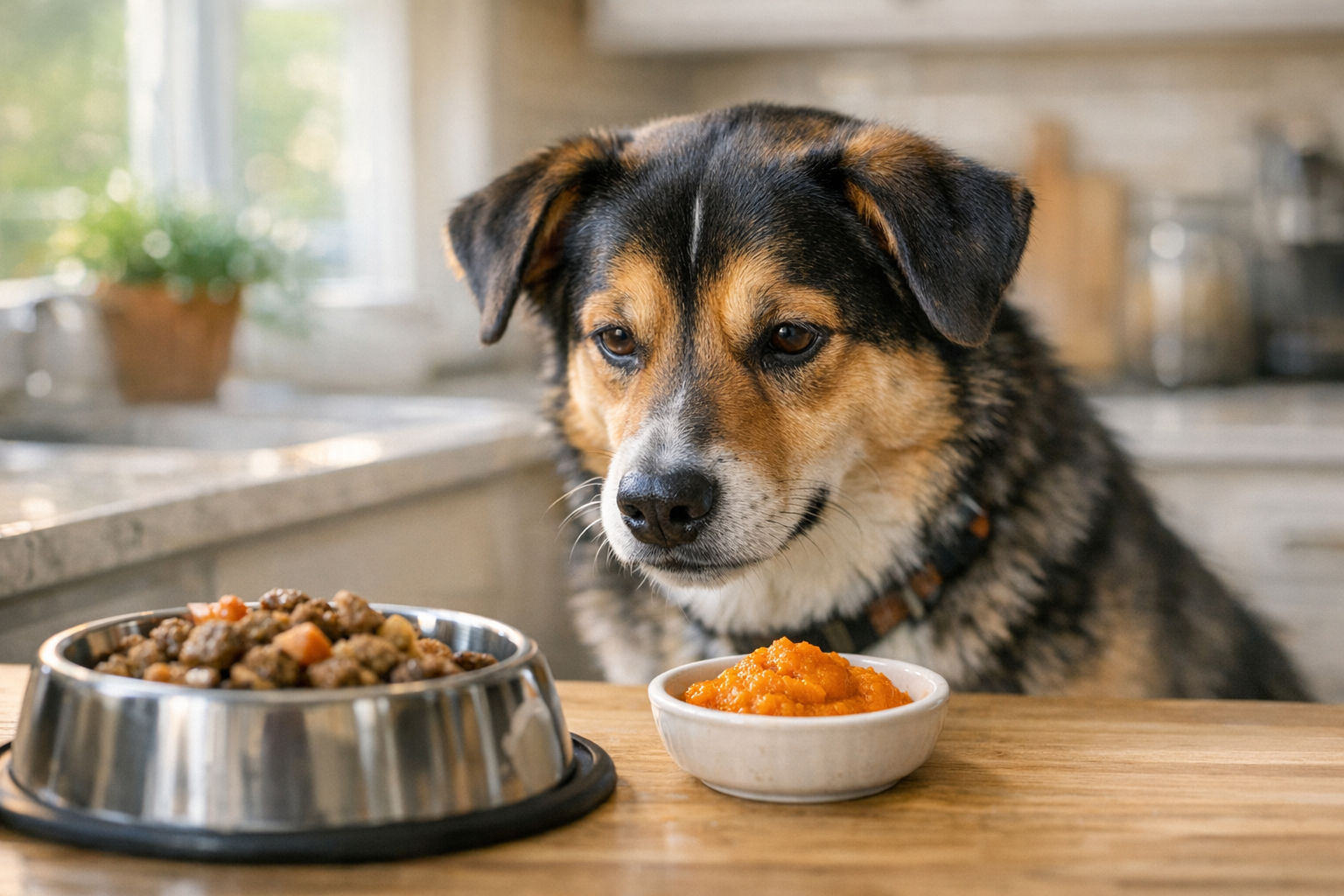
The easiest way is to mix it into your dog’s regular food.
Most dogs will eat it without any drama. If yours is suspicious, start with a smaller dab and stir it in well.
You can also freeze a spoonful inside a lick mat or food toy if your dog enjoys working for snacks. If you already use dog enrichment toys, pumpkin can be a good filling, as long as you count it as part of the total amount, not an extra on top.
Make sure your dog also has plenty of water. Fiber without enough water is not helpful. In a constipated dog, it can backfire.
Pumpkin dose examples by dog size and breed
A dog’s weight matters more than breed, but breed examples can make the portions easier to picture.
A Bavarian Mountain Scent Hound, for example, often lands in that medium range where 1 tablespoon is a sensible starting point.
A Large Munsterlander is usually a larger, active dog, so 1 to 2 tablespoons is often enough to start.
A giant breed like a Caucasian Shepherd Dog may tolerate 2 tablespoons well, but I still would not jump to the maximum right away. Big dog does not mean unlimited pumpkin.
Puppies are different. Their digestive systems are touchier, and diarrhea can turn serious quickly. If you have a puppy, use a very small amount and call your vet if the problem lasts more than a day, or sooner if your puppy seems weak, sleepy, or won’t eat.
When pumpkin is a bad idea
This is the part people skip, and it matters.
Do not give pumpkin and “wait it out” if your dog has:
- repeated vomiting
- a painful or swollen belly
- blood in the stool
- black, tarry stool
- severe lethargy
- refusal to eat for more than a meal or two
- straining with little or no stool coming out
- signs of dehydration
- a known history of bowel obstruction
Pumpkin is food. It is not treatment for a blockage, pancreatitis, poisoning, or a serious infection.
If your dog also feels hot, seems weak, or has diarrhea with low energy, it is worth learning how to check a fever at home. Fever plus stomach upset usually means you should stop guessing and call the vet.
If your dog seems nauseous, lip-smacks, paces, and has episodes of drooling and shaking, don’t count on pumpkin to sort that out. Those signs can mean pain, nausea, toxin exposure, or something else that needs real care.
Common mistakes owners make
Giving too much
This is the big one.
A tablespoon or two can help. Half a can can cause gas, cramping, or even looser stool. Stick to the ranges above, and start low.
Using the wrong product
Again, pie filling is not the same as puree. Read the label every time. Brand packaging can be surprisingly similar.
Treating symptoms that are not actually digestive
Owners sometimes think a dog is gagging, swallowing hard, or acting uncomfortable because of nausea, when the issue is something else entirely. I’ve seen dogs blamed for “stomach trouble” when they were coughing from pressure on the throat. If your dog looks off on walks, a quick collar fit guide is worth checking.
Trying to fix every problem at home
Pumpkin is fine for a mild tummy issue. It is not a general DIY medicine cabinet.
For example, if diarrhea leaves the skin around the rear irritated, don’t automatically reach for human ointments. Read up on Polysporin for dogs before putting anything on sore skin.
How long should you give pumpkin?
Usually 1 to 3 days is plenty.
If stool improves, taper off and go back to the normal diet. If stool does not improve within 24 to 48 hours, or your dog gets worse at any point, call your vet.
For chronic digestive trouble, don’t keep adding pumpkin forever. A dog who is constipated every week or has frequent loose stool needs a proper workup. The real issue could be diet, parasites, anal gland trouble, stress, inflammatory bowel disease, medication side effects, or something else entirely.
Can dogs eat pumpkin every day?
Some can, in small amounts.
A little pumpkin can work as a regular fiber add-in for dogs who do well with it. But daily use is not automatically right. Dogs with diabetes, food sensitivities, or special prescription diets should not have extras added casually.
If you want to feed it every day, ask your vet for a target amount based on your dog’s weight, diet, and health history.
Pumpkin puree for constipation vs diarrhea
People ask which dose to use for constipation and which dose to use for diarrhea. In practice, the starting amount is usually the same.
The better question is whether the problem is mild enough for pumpkin at all.
For mild constipation, start small, encourage water, and get your dog moving with a walk if they feel up to it.
For mild diarrhea, keep food bland only if your vet has told you to do that before, or if your dog has handled that approach well in the past. Otherwise, a small amount of pumpkin mixed into the regular food is often the simplest trial.
If either problem lasts more than a couple of days, stop experimenting.
The bottom line
So, how much pumpkin puree should you give a dog?
For most dogs, start with 1 teaspoon for very small dogs, 1 tablespoon for medium dogs, and 1 to 2 tablespoons for large dogs. Give it once or twice daily, use only plain puree, and reassess after the next bowel movement or two.
Pumpkin is a useful little tool. That’s all.
It can help a mildly off stomach. It cannot tell you why your dog is sick. If your dog has pain, repeated vomiting, blood in the stool, weakness, fever, or symptoms that feel bigger than a basic tummy wobble, skip the home fixes and get veterinary advice.