Why Is My Cat Licking My Other Cat's Bum?
A cat licking another cat's bum is usually normal allogrooming — a bonding behaviour studied in feline colonies. Learn when it signals a health issue instead.
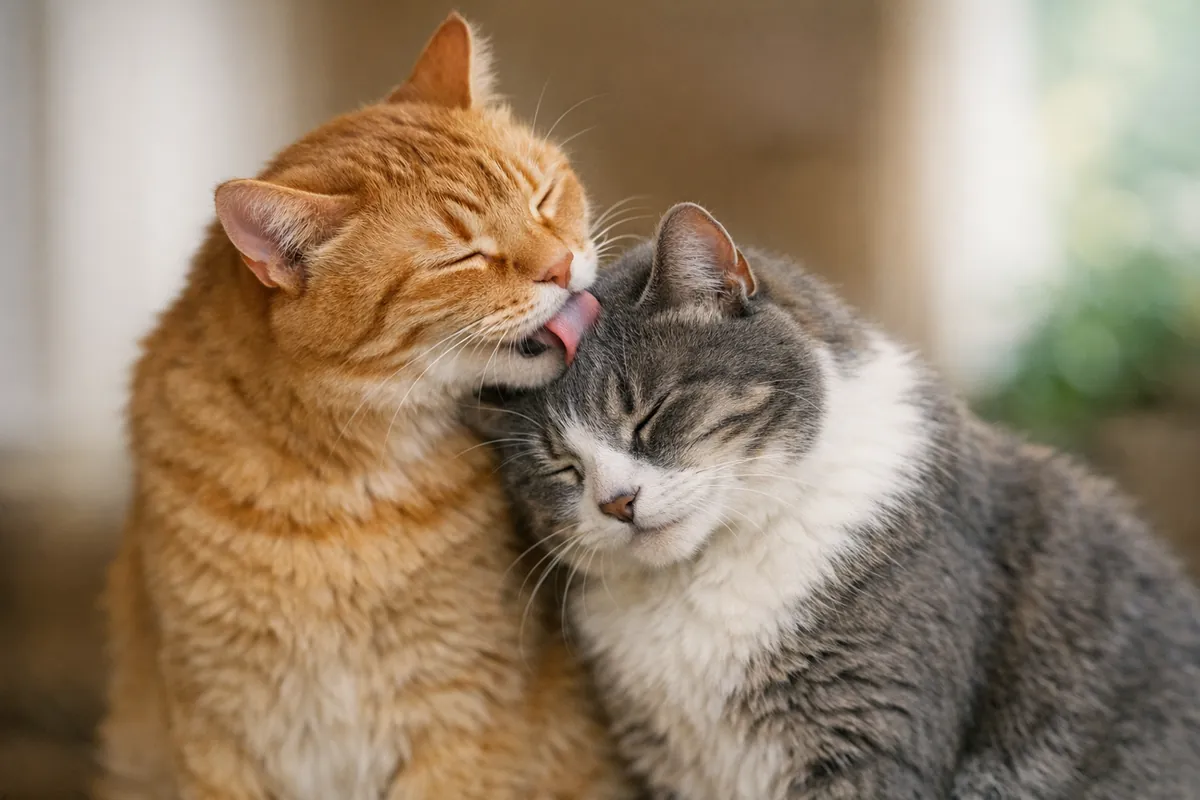
It's one of those things that makes you double-take — you glance over at your cats and one of them is very deliberately licking the other's backside. Is this normal? Should you intervene? Is something wrong with one of them?
The short answer is that this is almost always a completely normal feline behaviour. Cats that groom each other are displaying a form of social bonding called allogrooming, and the back end is simply one of the harder-to-reach spots that benefits from a partner. That said, there are specific circumstances where this behaviour can hint at an underlying issue worth paying attention to — in the cat doing the licking, the cat being licked, or both.
Here's what's actually going on.
TL;DR: One cat licking another's bum is almost always normal allogrooming — a feline social bonding behaviour. Research confirms allogrooming is one of the three primary ways cats form stable colony bonds (Journal of Veterinary Behavior, 2016). It only warrants concern if it's obsessive, one-sided, or accompanied by other symptoms.
If you're navigating multi-pet introductions, see our guide on how to introduce a kitten to a dog for managing the settling-in period.
What Is Allogrooming, and Why Do Cats Do It?
Allogrooming — the scientific term for when one animal grooms another — is one of the three primary behaviours through which domestic cats form and maintain bonded social groups, according to a 2016 study published in the Journal of Veterinary Behavior (Journal of Veterinary Behavior, 2016). For cats that live together and consider each other part of the same social unit, mutual grooming is a meaningful act of affiliation — not just practical hygiene.
It typically starts at the head and neck. These are areas cats can't easily reach themselves, so a willing partner provides real functional benefit. But grooming sessions don't always stay there. Cats extend the behaviour to the back, tail base, and yes — the anal region. This isn't deviant or unusual. It's a natural extension of what is, at its core, a cooperative social act.
The recipient cat almost always signals consent: they tilt their head, adjust their position, purr, and remain still. An allogrooming session that both cats are comfortable with looks relaxed and reciprocal — even if the roles don't always swap in the same session.
What the research shows: In one study on feline allogrooming dynamics, males initiated grooming sessions 90.4% of the time (Springer Nature Journal of Ethology). Allogrooming was also significantly more common between cats that were related or highly familiar to each other than between strangers — which means if your cats do this, it's actually a strong indicator of genuine social bonding rather than random behaviour.
It's Also About Scent Information
Cats gather an enormous amount of information through smell — far more than humans typically appreciate. The anal glands in cats produce a unique chemical signature that functions almost like a biological ID card: it conveys information about the individual's identity, health status, reproductive state, and emotional condition. When one cat sniffs or licks another cat's anal area, they're reading that information directly.
This is the same reason cats sniff each other's rear ends on first meeting. In a multi-cat household where the cats already know each other well, this information-gathering behaviour continues as a routine part of social interaction — it's how cats stay updated on each other's status. The licking component, rather than just sniffing, is an intensification of that information-gathering in cats that are comfortable enough with each other to make close physical contact.
It's also worth noting that cats have a specialised organ — the Jacobson's organ (or vomeronasal organ) — located in the roof of the mouth that allows them to process certain chemical signals more deeply than simple olfaction allows. When a cat licks and then does that slightly open-mouthed, blank-looking "flehmen response," this organ is at work. You may see this after a cat sniffs or licks the anal area of another cat.
Hygiene Assistance: Helping With Hard-to-Reach Areas
Cats are meticulous self-groomers, but they're not entirely flexible. The anal region is genuinely difficult for a cat to clean independently — they have to contort significantly to manage it, and older, arthritic, or overweight cats manage it even less effectively. A bonded companion licking this area may simply be providing practical hygiene assistance that the other cat either can't or doesn't bother to perform alone.
This is particularly common in bonded pairs where one cat is senior. If you notice that the younger or more mobile cat tends to groom the older one's rear more than the reverse, this could reflect a practical imbalance rather than a social one — the younger cat is filling a gap the older cat can no longer fill itself.
A pattern worth knowing: In multi-cat households, the cat doing most of the grooming is typically the more socially confident or dominant cat in the pair — not the submissive one. Dominant cats in stable groups redirect potential aggression energy into affiliative behaviours like allogrooming. So if one cat almost always grooms and the other almost always receives, that's normal feline social structure at work, not cause for concern.
When Could It Signal a Health Issue?
Most of the time this behaviour is benign. But there are specific scenarios where it can indicate something worth investigating — usually in the cat being licked rather than the one doing the licking.
Anal gland problems in the licked cat. Cats have two small anal sacs on either side of the anus that produce a pungent secretion. When these become impacted, infected, or inflamed, the scent changes noticeably — and other cats often detect this before owners do. If one cat is suddenly paying obsessive attention to another cat's rear, and that cat is also scooting, licking their own tail base excessively, or seems uncomfortable sitting, an anal gland issue in the licked cat is worth ruling out. A vet can assess and express blocked anal glands during a routine visit.
Parasites around the anal area. Tapeworm segments — which look like small grains of rice — migrate to the area around the anus and can be visible there intermittently. If one cat has a tapeworm burden, another cat may be drawn to the anal area by the smell or presence of these segments. Roundworms affect between 25% and 75% of cats according to Cornell University's College of Veterinary Medicine (Cornell University, 2024), with higher rates in kittens. If either cat is also showing a dull coat, vomiting, or a swollen belly, a faecal test for parasites is a simple and sensible step.
Skin irritation or dermatitis at the tail base. Flea allergy dermatitis commonly presents at the base of the tail and around the anal area. A cat with this irritation may hold themselves differently or be more receptive to grooming in that area than usual — which can prompt a bonded companion to groom there more. Check the skin at the tail base for scabs, hair loss, or visible flea dirt (which looks like black pepper that turns red-brown when wet).
For more on unusual cat behaviours linked to gut discomfort, see what it means when a cat keeps swallowing.
When Is the Licking Excessive or Problematic?
Normal allogrooming is relaxed, intermittent, and welcomed by both cats. You'll know it's crossed into something worth examining if:
The licked cat is clearly unhappy about it. A cat being groomed against its will — growling, moving away repeatedly, hissing when the other approaches — is not participating in a bonding ritual. Forced grooming can be a subtle expression of social tension or dominance conflict that needs addressing.
The licking is relentless and focused. Brief grooming sessions that happen naturally throughout the day are normal. A cat that repeatedly and intensely fixates on another cat's rear end — returning immediately after being interrupted, following the other cat specifically for this purpose — may be responding to a scent signal from a problem in the other cat (anal gland issue, infection, parasite).
There is visible soreness, redness, or hair loss on the licked cat. Excessive licking from another cat can cause skin irritation over time, particularly if the skin in that area is already compromised. If the licked cat's skin looks red, raw, or is losing hair around the tail or anal area, the cause should be investigated.
What to watch for: The most reliable indicator that this behaviour has shifted from normal to problematic is a change — if it's new, sudden, or dramatically more intense than before, something has changed that prompted it. Stable, long-established grooming patterns between cats that have lived together for years are almost always benign.
Should You Intervene?
In most cases, no. If both cats seem comfortable, the behaviour is brief and intermittent, and neither is showing any physical symptoms, intervening would interrupt normal and healthy feline social bonding.
If you want to be certain nothing physical is driving the behaviour, a routine vet check for both cats — including a faecal parasite screen and a quick anal gland assessment — is the simplest way to rule out a health cause and put your mind at ease.
If one cat clearly doesn't want to be groomed and the other is persisting, gentle interruption is fine. Providing the reluctant cat with more vertical space and more resources (litter trays, feeding stations, resting spots) can reduce social pressure in multi-cat homes that may be contributing to overgrooming dynamics.
Frequently Asked Questions
Is it normal for one cat to lick another cat's bum?
Yes, in most cases. Allogrooming — mutual grooming between cats — is one of the primary ways cats express social bonding in stable groups, per a 2016 study in the Journal of Veterinary Behavior. The anal area is simply hard to self-groom, so bonded cats often assist each other there. It only warrants concern if it's sudden, excessive, or unwelcome.
Why does my cat keep sniffing and licking my other cat's rear end?
Cats gather social and health information from the anal glands' chemical secretions — it's a form of biological communication. Licking intensifies this. If the behaviour has suddenly increased, it may signal a change in the other cat's scent due to anal gland impaction, a parasitic infection (roundworms affect 25–75% of cats, per Cornell University), or skin irritation around the tail base.
Could my cat have parasites if the other cat is licking its bum?
Possibly. Tapeworm segments around the anus are visible and odorous, which can attract another cat's attention. A faecal test is a quick, inexpensive way to rule this out. Cornell University notes roundworms affect between 25% and 75% of cats (Cornell, 2024), with higher rates in multi-cat or outdoor households.
Is this behaviour a sign that my cats like each other?
Generally, yes. Allogrooming is significantly more common between cats that are related, familiar, or considered preferred social associates — cats don't groom strangers this way. Research shows relatedness and familiarity are directly associated with how often cats choose to groom each other. If your cats are doing this willingly, it's a strong sign of genuine social affiliation.
When should I stop my cat from licking my other cat's bum?
Intervene if the licked cat is distressed by it (growling, fleeing, hissing), if the skin around the anal area looks red or raw, or if one cat is obsessively pursuing the other specifically for this purpose. In those cases, a vet check to rule out anal gland issues or skin problems in the licked cat is the right next step.