How to Keep Your Dog Off the Couch (Tips That Actually Work)
Learn how to keep your dog off the couch using reward-based training that works. Dogs trained with positive methods respond 90% of the time vs 30–50% with punishment.

You've told your dog to get off the couch a hundred times. They hop down, give you the look, and the moment you leave the room they're back up. It's one of the most common frustrations dog owners face — and most people go about fixing it the wrong way.
The couch isn't a behavior problem. It's a preference problem. Your dog isn't being stubborn or defiant. They've learned that the couch is warm, comfortable, and smells like you. Changing that equation means making another spot more appealing — not just making the couch off-limits through repetition and frustration.
This guide walks through exactly how to do that, step by step.
TL;DR: Keeping your dog off the couch requires three things: a clear, consistent "off" command, a better alternative resting spot, and every person in your household following the same rules. Dogs trained with reward-based methods respond correctly 90% of the time, versus just 30–50% with punishment-based approaches, according to peer-reviewed research (PMC, 2021).
Why Does Your Dog Want to Be on the Couch?
Dogs don't jump on the couch to test your authority. They do it because furniture is genuinely better than the floor — elevated, padded, temperature-regulated, and covered in your scent. That combination is hard to compete with.
The drive is also partly social. Dogs are pack animals, and elevation signals inclusion. When you sit on the couch and your dog wants to join you, they're not pushing boundaries. They're trying to be close to their person, which is a deeply wired instinct.
According to the American Pet Products Association's 2024 Dog and Cat Report, 17% of dog owners already let their dogs sleep on a couch or chair, and 76% let pets sleep in bed with them (APPA, 2024). The line between "allowed on furniture" and "not allowed on furniture" is drawn by household rules — and dogs can absolutely learn which rules apply, as long as those rules are applied consistently.
The biggest reason couch-training fails isn't the dog's stubbornness. It's inconsistency between family members. One person who lets the dog up — even occasionally, even "just this once" — resets the behavior almost entirely. Intermittent reinforcement (being rewarded sometimes, not always) actually strengthens a behavior more than consistent rewarding does. So the dog who's "sometimes" allowed up becomes harder to redirect than the dog who's never been invited at all.
Should You Let Your Dog on the Couch?
Before committing to a training plan, it's worth being honest about what you actually want. There's no universal answer here — letting your dog on furniture isn't harmful to them, and banning it isn't required for a well-behaved dog. The only thing that matters is consistency.
Reasons owners choose to ban couch access:
- Allergies or cleanliness concerns
- The dog is large and takes up too much space
- The dog has shown resource-guarding behavior around furniture
- Visitors are uncomfortable around dogs on furniture
Reasons owners choose to allow it:
- The dog is calm and well-behaved on the couch
- The owner enjoys the closeness
- The dog is anxious and the couch reduces stress
If you're reading this article, you've already decided the couch is off-limits. The steps below work. Stick with them.
How to Keep Your Dog Off the Couch: 6 Steps That Work
Reward-based training consistently outperforms punishment-based approaches. Dogs trained with positive reinforcement respond correctly to recall cues 90% of the time, compared to just 30–50% for dogs trained with corrections or aversive tools (PMC, 2021). That gap matters when you're trying to establish a lasting rule.
Here's how to apply that to couch training:
Step 1: Decide on the rule before you start
Pick a clear rule — "no couch ever" or "couch only when invited" — and commit to it before day one. Mixing the two is the fastest way to fail. If you want your dog off the couch entirely, the rule is never on the couch. If you're fine with invited access, teach a specific cue like "up" for permission and "off" for leaving.
Step 2: Teach the "off" command
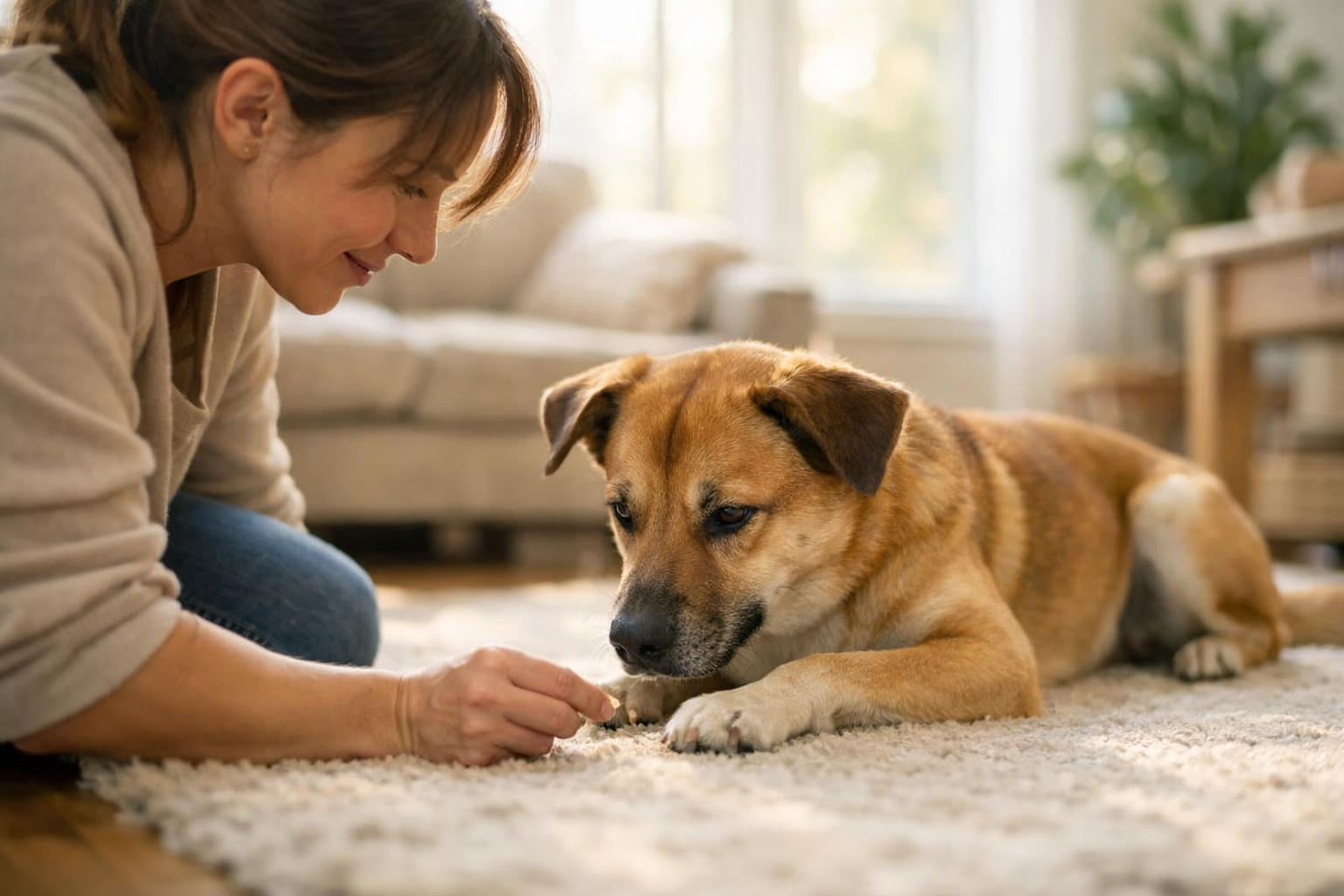
Start when your dog is already on the couch. Hold a treat near their nose, say "off" once, and lure them down. The moment all four paws hit the floor, mark with "yes" and give the treat. Practice this 5–10 times a day for one week. Don't repeat the word — say it once, then use the treat to guide them. Repeating commands teaches dogs they don't have to listen the first time.
Step 3: Redirect, don't just correct
When your dog jumps up without permission, say "off" calmly, wait for them to comply, then immediately direct them to their designated spot. Reward them heavily for going there. The goal isn't just to stop the unwanted behavior — it's to replace it with something your dog finds rewarding.
Step 4: Block access when you can't supervise
Dog-proof the couch when you leave the room. Flip couch cushions upright, use furniture covers with crinkly textures, or place a laundry basket on cushions. You can't train a dog you're not watching. Every unsupervised session on the couch reinforces the habit.
Step 5: Get everyone on the same page
Talk to every person in your household before starting. One person letting the dog up — even while training is going well — will undo weeks of work. Dogs don't generalize rules based on who's around. They learn what's allowed at any given moment.
Step 6: Be patient with regression
Most dogs show clear improvement within 1–3 weeks of consistent training. But expect setbacks, especially after guests visit or routines change. If your dog regresses, go back to basics — more frequent treat rewards, closer supervision, and physical barriers when you're not home.
Create an Irresistible Alternative Spot
The most effective long-term strategy isn't making the couch unpleasant. It's making the alternative better. Dogs don't give up comfort voluntarily — but they'll trade one comfortable spot for another if you make the swap worth their while.
Place your dog's bed as close to your usual seating area as possible. Dogs want proximity to their people more than they want the couch itself. A bed directly beside the sofa, at floor level, often satisfies that need entirely.
What makes a dog bed actually work:
- Orthopedic foam for medium and large breeds — it's warmer and more supportive than thin padding
- A worn t-shirt or blanket placed on the bed — your scent makes the spot feel safe
- Consistent rewards for choosing the bed voluntarily, even unprompted
For dogs that need more mental and physical engagement to settle down, pairing the bed with enrichment tools helps significantly. Check out the top 10 dog enrichment toys to find options that keep high-energy dogs occupied and calm enough to stay in one place.
Mistakes That Undo All Your Progress
Most couch-training failures come down to a handful of predictable errors. Knowing them in advance saves weeks of frustration.
Repeating commands. Saying "off, off, off" teaches your dog that one repetition doesn't count. Say it once. If they don't respond, use a treat to guide the behavior, not more words.
Punishing after the fact. Coming home to find your dog on the couch and scolding them accomplishes nothing. Dogs don't connect punishment to actions that happened minutes ago. The only effect is making your dog anxious around you — not more compliant about furniture.
Inconsistent rules. Research shows that dogs trained with aversive methods were 15 times more likely to display stress-related behaviors than those trained with consistent, reward-based methods (PMC, 2020). Unpredictable rules — whether the inconsistency is punishment or sporadic permission — produce the same anxious confusion.
Forgetting to reward the alternative. Most owners focus on stopping the couch behavior. Fewer remember to actively reinforce the dog bed. Rewarding your dog every time they choose their spot voluntarily accelerates the whole process.
The same principle applies to other boundary-related behaviors. If you're working on multiple training goals at once, see how to stop a dog from digging for a look at how consistent redirection works across different contexts.
What actually works: The most reliable turning point owners report is switching from "correcting the couch" to "rewarding the bed." When the bed becomes the place where good things happen — treats, praise, belly rubs — dogs start choosing it on their own. That shift usually happens within the second week of consistent training.
What to Do When Your Dog Ignores the Rules
Some dogs respond slowly to couch training — not because they're untrainable, but because the reinforcement history is long. A dog who's spent two years on the couch has thousands of rewarding experiences stacked up against a few weeks of new rules.
If progress is stalling, check these variables:
- Is the alternative spot actually comfortable? Test it yourself. If it's thin, cold, or positioned somewhere isolated, it won't compete with the couch.
- Is your dog getting enough exercise? Tired dogs settle more easily. A dog with excess energy will seek out comfort aggressively.
- Is one person still giving access? Even occasional exceptions are enough to slow training significantly.
If your dog seems anxious or distressed during training — panting, pacing, or refusing to settle anywhere — it may be worth ruling out underlying stress. A dog that looks sad or withdrawn during behavioral changes sometimes needs a slower transition rather than stricter enforcement.
Frequently Asked Questions
How long does it take to train a dog to stay off the couch?
Most dogs show consistent improvement within 2–3 weeks of daily training with reward-based methods. Dogs with long reinforcement histories on the couch (2+ years) may take 4–6 weeks. Consistency across all household members is the single biggest factor in how fast training works.
Is it okay to sometimes let my dog on the couch?
Yes — but only if you teach a clear "invite only" rule with a specific cue like "up" for permission and "off" for leaving. Allowing random access without a cue is the main reason couch-training fails. Dogs can learn conditional access reliably if the rules are always enforced.
Will my dog be unhappy if they can't get on the couch?
Not if you provide a good alternative. Dogs want proximity to their people more than the couch itself. A comfortable bed positioned near your seating area, combined with regular attention and enrichment, fully meets that need. Dogs trained with positive methods show significantly lower stress levels than those managed with corrections alone (PMC, 2020).
What can I put on the couch to keep my dog off?
Effective deterrents include flipped cushions, plastic carpet runners placed spike-side up, crinkly aluminum foil, or commercial pet mats that make a noise when touched. These work best as a temporary aid while you build the "off" command — physical deterrents alone rarely create lasting behavior change without training.
Do dogs understand "no" as a couch boundary?
Dogs don't generalize the word "no" to specific furniture rules — they learn through clear, consistent consequences. A well-trained "off" command paired with a rewarded alternative spot is far more effective than repeated "no" corrections, which dogs often tune out over time.
Conclusion
Keeping your dog off the couch isn't about dominance or discipline. It's about clearly communicating what you want and making the right behavior worth choosing. Teach a solid "off" command, give your dog a genuinely comfortable alternative, and make sure everyone in your home follows the same rules from day one.
The training timeline is realistic — most dogs make real progress within two to three weeks. The setbacks are predictable. And the fix, when things go sideways, is almost always the same: go back to rewarding the right behavior more than you're correcting the wrong one.
Key takeaways:
- Teach "off" with a treat lure, not repeated commands
- Block couch access whenever you can't supervise
- Place the dog's bed close to your usual seating spot
- Reward the alternative spot actively, every day
- Get every household member on board before you start