Top 10 Dog Enrichment Toys That Actually Work (2026 Guide)
98.2% of owners say enrichment toys provide mental stimulation. Here are 10 top dog enrichment toys for reducing boredom, anxiety, and destructive habits.
Most dogs get walks, meals, and cuddles — but almost no mental exercise. A 2024 study published in Veterinary Record found that 96% of dog owners who used enrichment feeding reported it prevented boredom, and 98.2% said it provided meaningful mental stimulation (Heys et al., Veterinary Record, 2024). The problem? Most owners still rely on the same flat bowl and the same walk — a routine that leaves a dog's brain almost entirely unchallenged.
Enrichment toys fill that gap. They slow eating, redirect destructive habits, reduce anxiety, and give dogs something purposeful to do. This guide covers the 10 best dog enrichment toys, how each works, and which types suit which dogs.
TL;DR: Dog enrichment toys reduce boredom and anxiety by giving dogs purposeful mental work. A 2024 Veterinary Record study found 98.2% of owners report enrichment feeding provides mental stimulation. Top picks include Kong Classic, snuffle mats, lick mats, puzzle feeders, and treat-dispensing balls — matched to your dog's drive and energy level.
Why Mental Stimulation Matters as Much as Physical Exercise
A tired dog is a good dog — but "tired" doesn't just mean physically exhausted. A 2025 analysis found that daily mental stimulation can reduce anxiety and aggressive behavior in dogs by up to 50% (Bark and Whiskers, 2025). Despite this, most dogs get under 15 minutes of genuine cognitive challenge per day — and the behavioral gap shows up fast.
Understimulation is the root cause of many of the habits owners find most frustrating: chewing furniture, excessive barking, digging, and restlessness. These aren't personality flaws. They're symptoms of a brain that hasn't been given anything useful to do. Enrichment toys redirect that energy into purposeful problem-solving — one that doesn't involve your couch cushions or baseboards.
The benefits extend beyond behavior. Mental stimulation is linked to lower cortisol levels, better sleep quality, and calmer interactions with other dogs. For anxious or reactive dogs especially, a daily enrichment routine can reduce the stress load that would otherwise express itself as barking or aggression during walks.
Worth knowing: Puzzle difficulty matters more than puzzle variety. Dogs habituate quickly to toys at the same difficulty level — the challenge disappears, and so does the engagement. Rotating across easy, medium, and hard puzzles maintains attention far longer than buying many toys at the same level. This is rarely mentioned in toy guides, but it's the single biggest factor in whether enrichment actually sticks as a habit.
If your dog still seems low-energy or disengaged despite regular activity, see why does my dog look sad for behavioral causes that enrichment alone won't address.
The Top 10 Dog Enrichment Toys in 2026
The dog enrichment toy market reached approximately $2.5 billion in 2025 and is growing at 7% annually (Research and Markets, 2025) — which means the options are overwhelming. These 10 types consistently deliver real cognitive benefit rather than just novelty.
1. Kong Classic (Stuffable Rubber Toy)
The Kong Classic is the most widely recommended enrichment toy in veterinary practice. Its hollow interior holds soft fillings — peanut butter, wet food, banana, plain yogurt — and the irregular bounce keeps dogs engaged long after the food is gone. Frozen Kongs last 3–4 times longer than room-temperature ones, stretching a single session to 20–30 minutes of sustained engagement.
Best for: Medium and large chewers, anxious dogs, crate training, dogs new to enrichment.
2. Snuffle Mat
A snuffle mat hides kibble or small treats in fabric loops, forcing dogs to use their nose to find them. Dogs have up to 300 million olfactory receptors compared to around 6 million in humans — sniffing genuinely tires them out faster than many physical activities. A 10-minute snuffle session can equal 30 minutes of walking in terms of mental fatigue for many dogs.
Best for: All ages, senior dogs, flat-nosed breeds, dogs recovering from surgery or injury.
3. Lick Mat
Lick mats use texture and repetition to calm. Spread peanut butter, pumpkin puree, cream cheese, or wet food across the surface, and the repetitive licking motion activates a natural calming response — releasing endorphins and lowering stress hormones. Veterinary behaviourists routinely recommend them during grooming sessions, vet visits, and thunderstorms. Freeze them overnight to double the engagement time.
Best for: Anxious dogs, bath and grooming time, high-stress situations, post-surgery recovery.
4. Treat-Dispensing Ball
Treat-dispensing balls replace the bowl entirely. The dog nudges, rolls, and paws at the ball to release kibble piece by piece — turning a 3-minute meal into a 15–20 minute problem-solving session. The Wobble Wag Giggle and Bob-A-Lot are among the most durable options available. Start with larger kibble openings and reduce them over time as your dog figures out the motion.
Best for: Food-motivated dogs, high-energy breeds, dogs who eat too fast and are at risk for bloat.
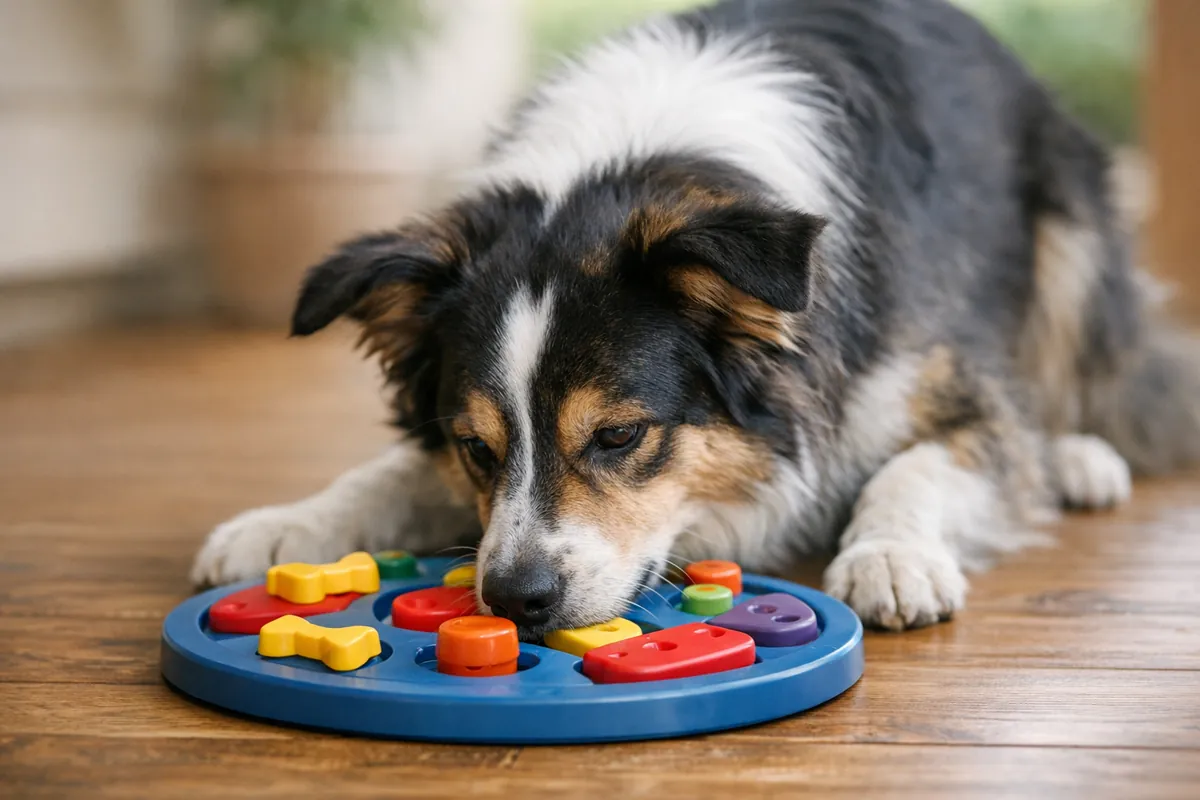
5. Puzzle Feeder (Sliding and Flipping Tray)
Nina Ottosson-style puzzles require dogs to slide panels, flip covers, and lift pieces to uncover treats underneath. They come in difficulty levels 1–4 — most beginners do best starting at Level 2, then progressing as they succeed. Start easy enough that the dog doesn't give up in frustration, and watch for the engagement sweet spot: 5–15 minutes of focused work with occasional pauses. These are the toys most directly linked to cognitive engagement in enrichment research.
Best for: Intelligent breeds (Border Collies, Poodles, Australian Shepherds), dogs with too much focus energy, dogs who finish other toys in under two minutes.
6. Chew Toys (Yak Chews, Antlers, Bully Sticks)
Long-duration chewing is one of the most underused enrichment categories. The act of sustained chewing releases serotonin and reduces cortisol — it's mood regulation, not just jaw exercise. Natural options like Himalayan yak chews last hours and don't splinter like rawhide. Bully sticks are softer and better for moderate chewers. Antlers are the most durable but require supervision for aggressive chewers.
Worth knowing: Many owners skip chew toys because they assume chewing isn't "real" enrichment. In practice, a dog who has had a 20-minute chew session is measurably calmer and significantly less likely to seek stimulation through destructive behavior for the next few hours. The sustained physical act of chewing is cognitively settling in a way that a 5-minute fetch session often isn't.
Best for: Power chewers, dogs with destructive chewing habits, dogs who can't do high-intensity toys due to injury or age.
7. Hide-and-Seek Plush Sets
These are plush toys-within-toys: a burrow (a log, a barn, a bag) that holds smaller plush animals the dog finds and removes one by one. They tap into prey drive and foraging instinct, which is behaviourally distinct from chewing or eating-based enrichment. Dogs who get bored quickly with stationary puzzle toys often engage much longer with these because of the physical unpacking element.
Best for: Scent-oriented breeds (Beagles, Dachshunds, Spaniels), gentle chewers, dogs who cycle through single toys fast.
8. Flirt Pole and Tug Toys
Tug is one of the most effective enrichment formats because it's simultaneously social, physical, and mentally engaging. A flirt pole — a long wand with a lure on the end — exhausts high-energy dogs in under 10 minutes of play and requires real decision-making from the dog (when to chase, when to pounce, when to stop). Interactive tug ropes with handles or bungee extensions let owners participate without hand-to-mouth contact.
Best for: Terriers, herding breeds, dogs with high prey drive, dogs who need an outlet for frustration energy.
9. Slow Feeder Bowl
A slow feeder bowl adds maze-like ridges that force dogs to eat around obstacles, slowing meal consumption by 5–10x. This reduces bloat risk, improves digestion, and extends the "work" of eating into genuine problem-solving. They're among the most accessible enrichment tools — inexpensive, dishwasher-safe, and usable at every single meal without any extra prep.
Best for: Fast eaters, large breeds prone to bloat, budget-conscious owners, dogs new to enrichment.
10. DIY Muffin Tin Puzzle
Place kibble in a muffin tin and cover each cup with a tennis ball. The dog has to lift or nudge each ball to find the food. It costs nothing extra if you already own a muffin tin, and difficulty scales easily — use only some cups, use larger balls, add crumpled paper as an extra layer. Professional enrichment trainers consistently recommend this as the best zero-cost starting point for dogs new to puzzle feeding.
Best for: Beginners, puppies, budget-conscious owners, dogs being introduced to enrichment for the first time.
How Do You Match Enrichment Toys to Your Dog?
Not every toy works for every dog — and a toy your dog ignores provides zero enrichment. A 2024 Veterinary Record study found that Kongs, chews, and activity toys were the most common enrichment forms among surveyed owners (Heys et al., 2024), but popularity doesn't predict what an individual dog will engage with.
The simplest matching approach starts with motivation type. Highly food-motivated dogs will have immediate buy-in with treat-dispensing toys and puzzle feeders. Toy-motivated dogs respond better to plush hide-and-seek sets and flirt poles. Nose-oriented breeds (Beagles, Bloodhounds, Bassets) engage well with snuffle mats and foraging activities regardless of food motivation level.
Difficulty matching matters just as much. A toy that's too easy gets abandoned within two minutes. A toy that's too hard causes frustration, disengagement, and sometimes avoidance of enrichment entirely. The right level produces 5–15 minutes of focused effort with short pauses — the dog keeps coming back to it rather than walking away.
A simple rotation strategy that works: Keep 3–4 toys accessible at any time, cycling two out every week. Dogs show significantly more interest in toys they haven't seen in 5–7 days compared to identical toys left out continuously. Novelty drives engagement. Rotation beats buying more toys — it's free, takes 30 seconds, and sustains interest far longer than a larger toy collection left out all at once.
For dogs who lick floors, walls, or carpets compulsively even with enrichment in place, see why is my dog licking the floor — the cause is sometimes behavioral, but often medical.
Frequently Asked Questions
How many enrichment sessions should a dog have per day?
Most dogs benefit from 2–3 enrichment sessions daily, totalling 20–45 minutes of active engagement. A 2024 owner survey found that 96% who used enrichment feeding reported it prevented boredom (Veterinary Record, 2024). Even a single 15-minute session per day produces a measurable difference in anxiety levels and destructive behavior frequency.
Are enrichment toys safe for puppies?
Yes, with size-appropriate selection. Avoid small pieces that could be chewed off and swallowed, skip toys with detachable parts for dogs under 6 months, and supervise every first session with a new toy. Snuffle mats, lick mats, and large Kongs are the safest starting points for young dogs still learning how to interact with objects.
Can enrichment toys help with separation anxiety?
Enrichment toys are a useful management tool for mild separation anxiety — a frozen Kong or puzzle feeder left at departure gives the dog a productive focal point during the transition. For moderate to severe separation anxiety, toys alone won't resolve the underlying issue and a structured behavior modification program is needed alongside enrichment.
What's the best enrichment toy for a senior dog?
Snuffle mats and lick mats are consistently best for senior dogs — low-impact, mentally engaging, and fully usable regardless of joint issues or reduced mobility. Avoid high-intensity toys requiring jumping or rapid movement. Cognitive stimulation is especially important in older dogs to support brain health and slow cognitive decline.
What if my dog isn't interested in any enrichment toy?
Start with the DIY muffin tin puzzle using your dog's regular kibble — the familiarity of their own food removes the novelty barrier. If disinterest persists, rule out health or pain issues first. A dog experiencing discomfort often shows reduced interest in food-based games and play. See the 10 most common dog diseases for conditions worth ruling out.
The Bottom Line on Dog Enrichment Toys
Mental stimulation isn't optional for dogs — it's as fundamental as exercise and nutrition. Daily enrichment can reduce anxiety and aggressive behavior by up to 50% (Bark and Whiskers, 2025), and the 10 toys above are the most practical, vet-recommended ways to deliver that stimulation at home.
Start with one or two toys that match your dog's primary motivation. Rotate them regularly, increase difficulty as your dog advances, and treat enrichment as a daily habit rather than an occasional bonus. The behavioral difference tends to be noticeable within a week or two.
- Food-motivated dogs: treat-dispensing balls, Kongs, puzzle feeders
- Nose-driven dogs: snuffle mats, hide-and-seek plush sets
- Anxious dogs: lick mats, chew toys, frozen Kongs
- High-energy dogs: flirt poles, tug toys, advanced puzzle feeders
- Beginners: muffin tin puzzle, slow feeder bowl, snuffle mat
For more on keeping your dog healthy and behaviourally balanced, see the 10 most common dog diseases and how to stop a dog from digging — both issues that enrichment routines help reduce significantly.