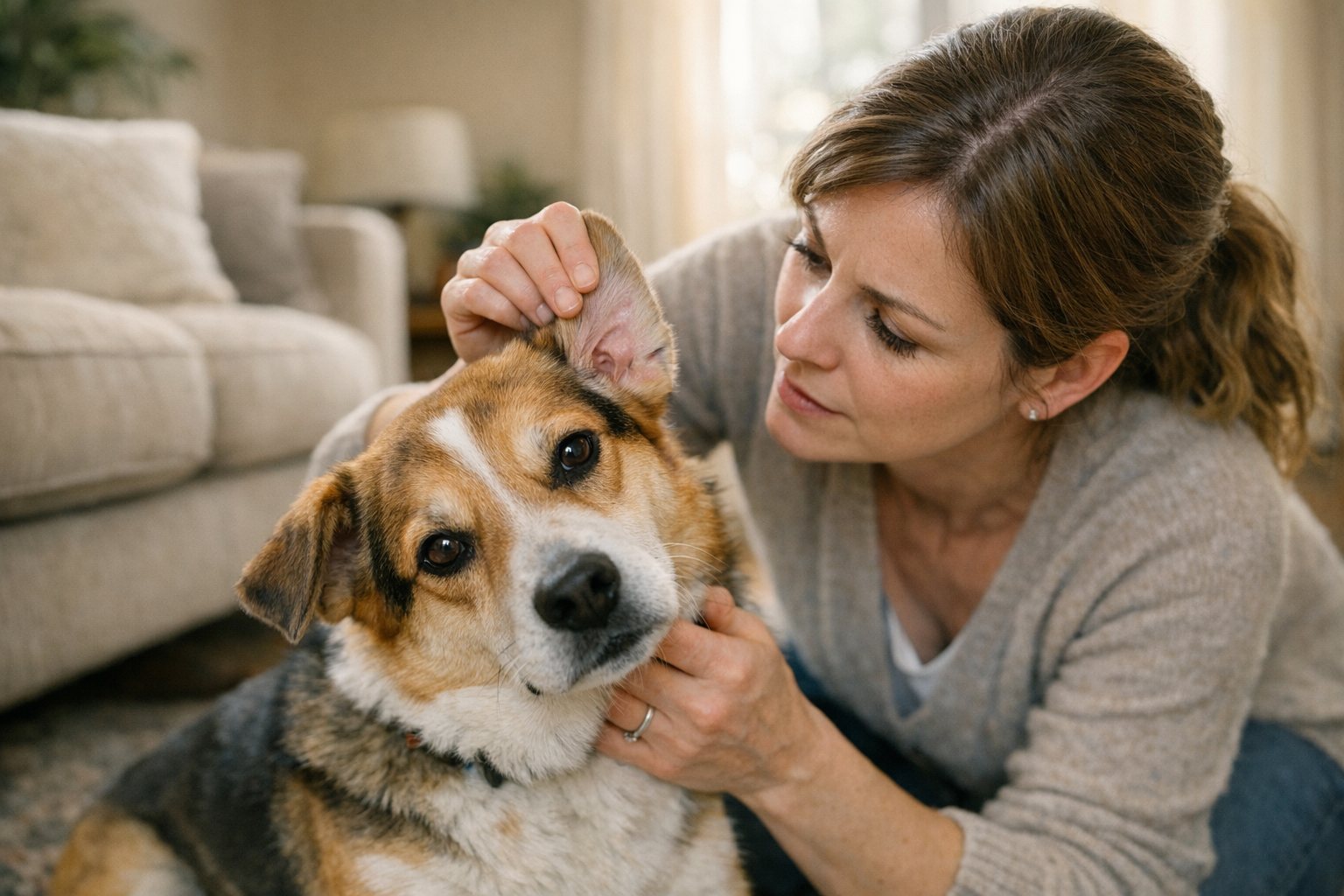
How Tight Should a Dog Collar Be?
Wondering how tight should a dog collar be? Use the two-finger rule, spot bad fit fast, and choose the safest collar for walks and daily wear.
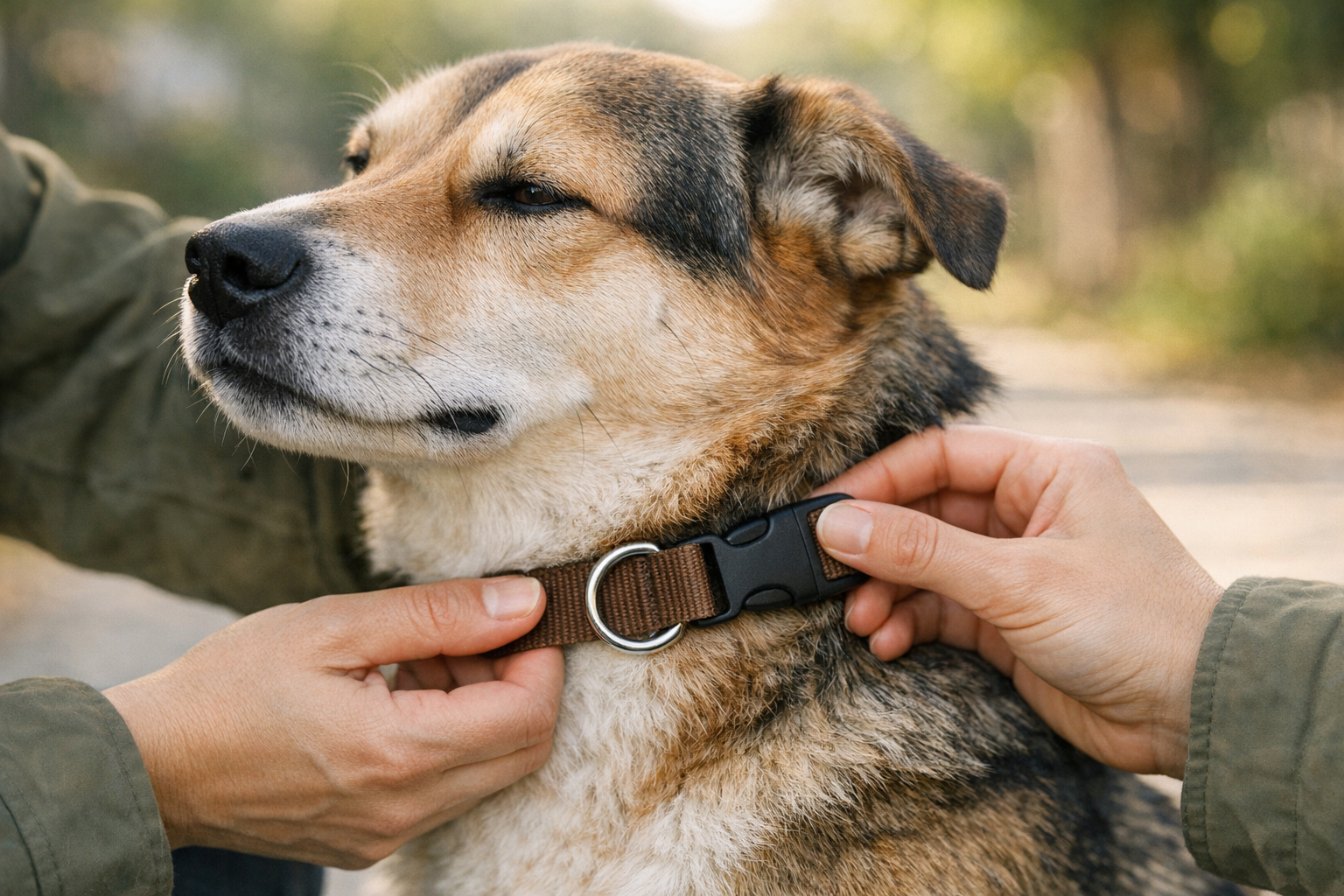
The short answer is this: a dog collar should be snug enough that it will not slip over your dog's head, but loose enough that you can slide two fingers underneath without forcing them.
That simple rule works for most dogs, but not all. A tiny Chihuahua, a thick-coated spaniel, and a lean Greyhound do not wear collars the same way. Collar width, coat, age, and what the collar is actually for all matter.
Start with the two-finger rule
If you can slide two fingers between the collar and your dog's neck, and those fingers fit comfortably without digging, you are usually in the right range.
If you have to jam your fingers under the collar, it is too tight. If you can pull the collar far away from the neck or rotate it too easily, it is probably too loose.
The two-finger rule is a starting point, not a law of physics. On a giant dog with a broad neck, two tiny fingers can still leave the collar too snug. On a toy breed, two large fingers may make it dangerously loose.
So use your eyes too. The collar should sit flat against the neck. It should not pinch, gap badly, or slide over the ears when your dog backs up.
What a properly fitted collar should look like
A good collar fit is pretty boring. That is what you want.
It stays in place when your dog walks, sniffs, and shakes off. It does not leave a deep dent in the fur. It does not rub the skin raw. And it does not ride up so high that it presses into the throat every time the leash tightens.
For most adult dogs wearing a standard flat collar, the buckle sits centered or close to centered. The tags hang freely. The collar feels secure, but you can still move it slightly around the neck.
If your dog has very thick fur, do not judge fit by fluff alone. Spread the coat with your fingers and feel the actual neck. I have seen plenty of fluffy dogs wearing collars that looked loose from the outside but were far too tight underneath.
Signs the collar is too tight
This is where owners get caught out, especially after a puppy growth spurt or a grooming change.
A too-tight collar can cause:
- coughing or gagging when pressure is applied
- fur loss around the neck
- red or irritated skin
- a bad smell under the collar from trapped moisture
- reluctance to have the collar touched
- rubbing or scratching at the neck
- a visible indentation after you remove it
If the skin is broken, moist, scabby, or infected, do not just loosen the collar and hope for the best. Clean, dry skin can often settle once the pressure is gone. Damaged skin usually means a vet visit within 24 hours, especially if your dog seems sore.
Watch for behavior changes too. Some dogs stop wanting to go for walks because they have learned that collar pressure hurts. That gets mistaken for stubbornness all the time.
Signs the collar is too loose
Loose sounds safer, but it is not always.
A collar that is too loose can slip over your dog's head. That is one of the quickest ways to lose a dog near traffic, wildlife, or another dog.
It can also snag on things. Dogs can catch a loose collar on a crate bar, fence wire, branch, or even another dog's jaw during play. That risk is real, which is one reason many owners remove collars indoors when supervision is low.
A too-loose collar also twists more than it should. Tags end up under the chin, the buckle slides constantly, and some dogs can get a paw caught while scratching.
How to check collar fit the right way
Do this when your dog is standing, not curled up on the couch and not mid-zoomie.
First, place the collar where it normally sits. For a flat everyday collar, that is usually around the middle of the neck, not high up under the jaw.
Then slide two fingers under it. Use a normal amount of pressure. You are checking for a comfortable fit, not trying to prove that your fingers fit no matter what.
After that, try a real-world test. Gently guide your dog forward, then let them back up a step. If the collar can roll over the ears or head with light movement, it is too loose.
Finally, check the skin and fur under the collar every few days, more often for puppies and long-coated dogs. A collar can seem fine until you part the fur and find redness or mats.
Puppies need more frequent checks
Puppies can outgrow a collar shockingly fast. Sometimes within a week or two.
If your dog is still growing, check the fit at least weekly. More often for fast-growing breeds. A collar that fit perfectly last Saturday can be tight by this Saturday, and puppies are not good at telling you why they are suddenly cranky.
Weight changes matter too. A dog who gains muscle, gains fat, or loses weight after illness may need a different setting. Seasonal coat changes can affect fit as well.
Coat and breed make a big difference
Short-coated dogs make collar problems easy to spot. You see the rubbing fast.
Long-coated dogs are trickier. Thick fur can hide pressure, trapped moisture, skin irritation, and mats. Sporting breeds with heavy feathering or curly coats often need more hands-on checking around the neck.
If you live with a Field Spaniel, for example, do not assume the collar is fine just because it disappears into the coat. The neck fur can mat under a slightly tight collar before you notice.
The same goes for an Irish Water Spaniel, especially if that curly coat gets damp often. Wet fur under a collar can rub and stay irritated much longer than owners expect.
Some body shapes need special thought too. Broad-headed dogs may need a different buckle position than narrow-headed dogs. Sighthounds often do better with collars designed for their neck-to-head shape, because a regular flat collar may slip off even when it seems snug.
The type of collar matters
Not every collar should fit exactly the same way.
A standard flat collar for ID tags and normal daily wear should be snug but comfortable. This is what most people mean when they ask how tight a dog collar should be.
A martingale should sit loose until tension is applied, then tighten only enough to prevent escape, not choke the dog. If a martingale closes completely or keeps tightening with no stop, it is set wrong.
Slip leads and choke-style collars are a different conversation. I am not a fan of using pressure-based tools casually, because plenty of dogs end up with throat irritation and worse behavior, not better. For dogs who pull, a well-fitted harness is usually the better first move.
Breakaway collars have their place for safety in some situations, but I would not use one on leash walks unless it is specifically designed for that purpose. You do not want the collar popping open in the street.
Should your dog wear a collar all the time?
In my opinion, not always.
If your dog is actively supervised, a flat collar with ID is practical. If your dog is crated, roughhousing with other dogs, or hanging out unsupervised where collars can snag, taking it off is often safer.
A lot of at-home collar accidents happen in ordinary settings. Dogs play, a jaw gets caught, panic kicks in, and things go bad fast.
For dogs who wear a collar most of the day, make neck checks part of your routine. When you are doing a quick once-over, look at paws too. If you notice dog nails turning white, that is another sign your regular care routine needs a closer look.
Common mistakes owners make
The biggest one is fitting the collar over fur instead of to the neck.
The second is setting it once and forgetting it. Dogs change. Coats change. Gear stretches. Leather softens. Nylon loosens a bit over time.
Another common mistake is using the same fit for every purpose. A collar that is fine for wearing ID around the house may not be the best choice for a strong dog on leash walks.
And then there is the rescue-dog problem. Owners are so worried about a dog slipping out that they make the collar too tight. I understand the fear, but pressure on the throat is not the answer. If your dog is an escape artist, use a secure harness and train against backing up.
If your dog is coughing, gulping, or scratching, do not blame the collar automatically
Sometimes the collar is the whole problem. Sometimes it is just revealing one.
If your dog coughs only when the leash tightens, the equipment and handling are probably involved. If the coughing, gulping, lip licking, or repeated swallowing happens even with no collar pressure, think more broadly.
Throat irritation, dental pain, nausea, allergies, kennel cough, and even anxiety can cause similar signs. If loosening or removing the collar does not help quickly, get your vet involved.
People with multiple pets often assume these odd motions mean the same thing across species, and they do not. A cat showing repeated gulping has its own list of causes, which is why our piece on cat keeps swallowing is useful if you have a feline doing something similar.
The same goes for overgrooming or odd licking behaviors in cats. Neck irritation from a collar is one thing in dogs. Rear-end grooming in cats is a very different issue, and cats lick each other's bum for reasons that surprise a lot of owners.
So, how tight should a dog collar be?
Tight enough that it cannot slip over the head during normal movement. Loose enough that you can comfortably slide two fingers underneath and the collar does not press into the skin or throat.
If you want the plain-English version, your dog should barely notice it. No choking. No rubbing. No escaping.
Check the fit regularly, especially for puppies, long-coated dogs, and any dog whose weight or coat has changed. And if the collar is doing more than holding ID tags, step back and ask whether a harness would be the kinder, safer tool.
A well-fitted collar is simple. That is the whole point.