Cat Keeps Swallowing? Common Causes Explained
A cat that keeps swallowing repeatedly may have nausea, dental pain, acid reflux, a hairball, or something lodged in the throat. Here's how to tell each cause apart.
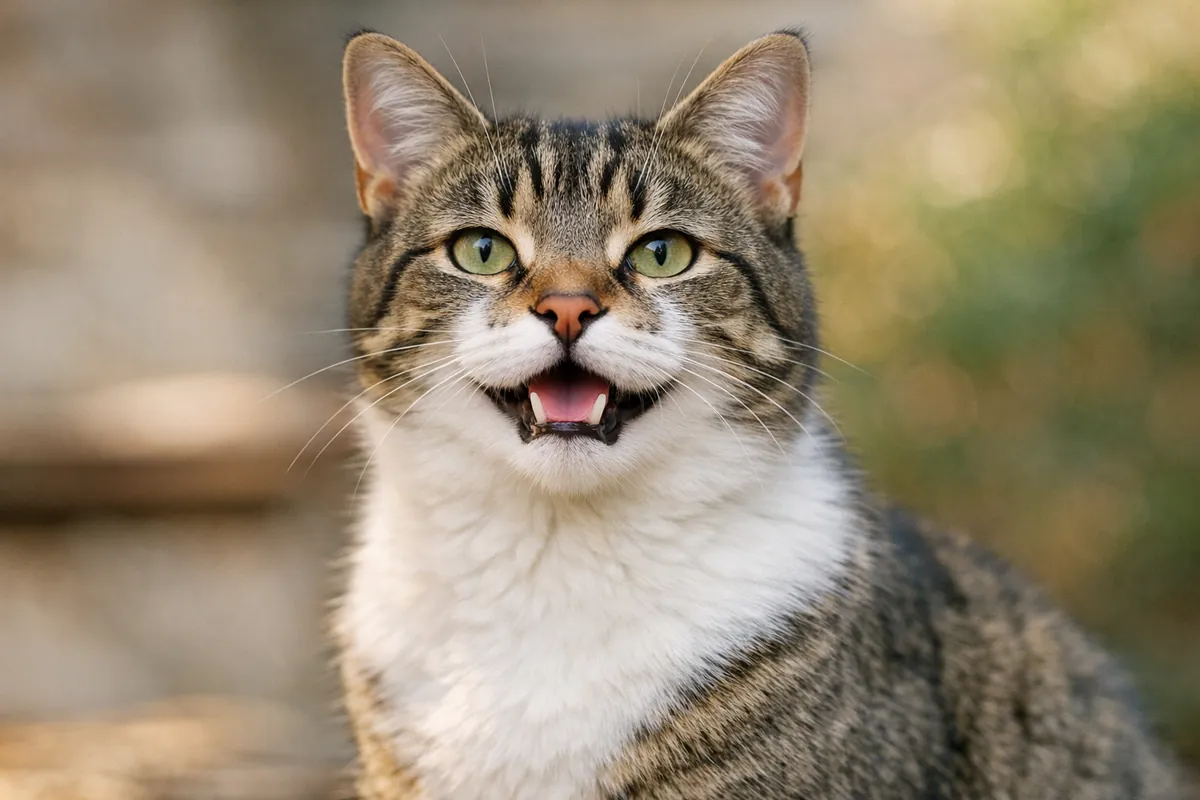
You're watching your cat sit quietly when you notice it — a repeated, deliberate swallowing motion. No food nearby. No hairball coming up. Just that rhythmic gulping that seems slightly off. Is it serious, or just a normal cat thing?
Repeated swallowing in cats is almost always a sign that something is irritating or uncomfortable in the mouth, throat, or stomach. The motion itself is a reflex response to that discomfort — the body's attempt to clear or soothe whatever's bothering it. The cause can range from mild and self-resolving to a genuine veterinary emergency depending on what's driving it.
This guide covers every common cause, what to look for alongside the swallowing behaviour, and when to act fast versus when to monitor.
TL;DR: Repeated swallowing in cats most often signals nausea, dental pain, or acid reflux — all of which are common and treatable. Dental disease affects up to 90% of cats over age four (Cornell University). A cat swallowing repeatedly with drooling, pawing at the mouth, or refusing food needs a vet visit.
For more detail on what this behaviour indicates, see what excessive swallowing in cats actually means.
Nausea: The Most Overlooked Cause
Nausea is the single most common reason a cat repeatedly swallows. When a cat feels queasy, the body produces excess saliva as a precursor to vomiting — and the cat swallows repeatedly to manage it. Unlike dogs, cats rarely signal nausea obviously. There's no drooling on the floor, no obvious retching posture. Just that quiet, repeated swallowing that owners often miss for days or weeks.
What makes this tricky is that nausea itself is a symptom, not a diagnosis. The underlying drivers vary widely: chronic kidney disease, liver dysfunction, inflammatory bowel disease, pancreatitis, intestinal parasites, or a reaction to a recent medication. In older cats especially, unexplained nausea and repeated swallowing that appeared gradually are often the first visible sign of kidney disease — a condition affecting roughly 30–40% of cats over 12 years of age (International Cat Care, 2024).
Worth noting: Many owners see their cat swallowing repeatedly and assume it's about to vomit a hairball — then nothing comes up and the behaviour continues for days. When no hairball follows, nausea from a systemic cause (not a physical blockage) is far more likely than owners realise.
Look for these alongside the swallowing: lip-licking, turning away from food, sitting hunched with a slightly tucked posture, or intermittent vomiting of bile or clear liquid. Any combination suggests nausea that deserves a vet check rather than watchful waiting.
Dental and Oral Pain
Between 50 and 90% of cats older than four years have some form of dental disease, according to Cornell University's College of Veterinary Medicine (Cornell, 2024). By age two, 70% already show early periodontal changes. Dental pain — from gingivitis, tooth resorption, a broken tooth, or oral ulcers — is an extremely common and frequently missed cause of repeated swallowing in cats.
The mechanism is straightforward: pain in the mouth triggers excess salivation, and the cat swallows repeatedly to deal with it. Cats rarely paw at their mouths or cry out in dental pain — their instinct is to conceal discomfort. The swallowing behaviour can be the only outward sign for weeks.
What to watch for alongside it: dropping food while eating, eating only on one side of the mouth, reduced food interest, bad breath that's noticeably worse than usual, or visible redness along the gumline. Any of these alongside repeated swallowing strongly suggests oral pain requiring a dental exam.
Acid Reflux and Esophagitis
Feline gastroesophageal reflux — acid reflux — is considered significantly underdiagnosed in cats (Veterinary Clinics: Small Animal Practice, 2021). Stomach acid that travels upward into the esophagus causes esophagitis: inflammation of the esophageal lining. Cats with esophagitis swallow repeatedly in an attempt to clear or soothe the burning sensation.
Unlike humans with reflux who often report heartburn, cats express it primarily through behaviour: repeated gulping, regurgitation shortly after eating (distinct from vomiting — it comes up with little effort and looks undigested), extending the head and neck in an uncomfortable posture, and reluctance to eat despite being hungry. Some cats will eat enthusiastically then immediately sit still and swallow repeatedly for 10–15 minutes after a meal.
Esophagitis in cats has several triggers beyond spontaneous reflux. It's a documented complication of doxycycline — a commonly prescribed antibiotic — when given as a dry tablet without adequate water afterward. Post-anaesthetic reflux during surgical procedures is another well-established cause. If your cat developed this behaviour after a recent surgery or antibiotic course, esophagitis should be near the top of the list.
A pattern we see often: Cats that swallow repeatedly specifically after meals, rather than continuously throughout the day, are much more likely to have a reflux or motility issue than a systemic illness. Timing relative to food is one of the most useful clues when working out the cause.
Hairballs: When They're Stuck, Not Just Forming
Hairballs cause repeated swallowing in two distinct situations. First, when the mass is forming in the stomach and the cat is actively trying to expel it — you'll usually see retching or productive vomiting following the swallowing phase. Second, more seriously, when a hairball or accumulated hair becomes partially lodged in the esophagus and the cat is attempting to swallow it further down or bring it back up.
Hairballs are the number one condition reported by cat owners, cited by 35% of households in a Hill's Pet Experience Study. Most cats produce fewer than one hairball per month — any cat producing more than one per week is showing a sign that something else may be wrong, such as excessive grooming from stress, a skin condition, or an underlying gastrointestinal motility issue (Cornell University, 2024).
The distinguishing sign for a hairball-related cause is the pattern: repeated swallowing or retching in discrete episodes (usually lasting minutes), often following a grooming session, with eventual production of a cylindrical fur mass or bile. A cat that swallows continuously throughout the day without episodes of retching is unlikely to have a hairball as the primary cause.
Foreign Body in the Throat or Esophagus
A piece of bone, a needle, a string, or any small object lodged in the pharynx or esophagus will cause immediate and persistent swallowing attempts as the cat tries to either push it down or expel it. This is a less common cause than the others listed above, but it's the one that requires the most urgent response.
Foreign body obstruction typically presents acutely and dramatically — the swallowing behaviour starts suddenly rather than gradually, and is often accompanied by distress, pawing at the mouth, open-mouth breathing, hypersalivation, gagging, or complete refusal to eat. The cat may seem panicked or agitated rather than quietly uncomfortable. String ingestion is particularly dangerous in cats — if any string is visible in the mouth with the other end potentially further down the digestive tract, do not pull it.
If you suspect a foreign body, this is not a wait-and-see situation. Esophageal obstructions can perforate the esophageal wall within hours if not addressed.
Upper Respiratory Infection and Post-Nasal Drip
Upper respiratory infections — caused by feline herpesvirus, calicivirus, or bacterial pathogens — can cause repeated swallowing through two mechanisms. First, post-nasal drip: mucus draining from inflamed nasal passages into the throat triggers a swallowing reflex. Second, oral ulcers caused by calicivirus are painful enough to produce the same hypersalivation-and-swallow pattern seen with dental disease.
This cause is usually easier to identify because respiratory signs accompany the swallowing: sneezing, nasal discharge, watery or crusty eyes, or reduced sense of smell leading to reduced food interest. Kittens and cats in multi-cat households are more susceptible. Most URI cases resolve with supportive care, though secondary bacterial infection may require antibiotics.
If your cat is swallowing repeatedly alongside any respiratory symptoms, an upper respiratory infection is a strong candidate — particularly if they've recently been in contact with other cats or came from a shelter environment.
If you've recently added a new cat to the household, see our guide on how to introduce a kitten to a dog for managing multi-pet settling-in.
Anxiety and Compulsive Swallowing
Less commonly, cats swallow repeatedly as a stress response or compulsive behaviour — particularly in cats with chronic anxiety, significant environmental change, or a history of food insecurity. The mechanism involves heightened salivation during stress states, producing the same swallow reflex seen with physical causes.
Stress-related swallowing is typically a diagnosis of exclusion — it's reached after physical causes have been ruled out by a veterinarian. Signs pointing toward a behavioural component include the swallowing occurring more often during specific situations (visitors, loud noises, a new pet in the home), alongside other stress indicators like over-grooming, hiding, or changes in litter tray behaviour.
How to Tell the Causes Apart at Home
Before your vet appointment, these observations are worth making and noting down:
Timing: Does the swallowing happen continuously, in episodes, or specifically after meals? After-meal swallowing suggests reflux. Episodic retching suggests hairball. Continuous swallowing throughout the day suggests nausea or oral pain.
What accompanies it: Drooling, pawing at the mouth, or bad breath points to oral pain. Lip-licking and food refusal suggests nausea. A sudden onset with distress suggests foreign body.
Duration: Has this been happening for days or weeks (suggests a chronic cause like dental disease or reflux) or did it start abruptly today (raises suspicion of foreign body or acute illness)?
Age: Older cats swallowing repeatedly alongside any appetite or weight change should be evaluated for kidney or liver disease without delay. Kittens swallowing excessively are more likely to have a foreign body or URI.
Our observation: Among the causes listed above, dental pain is the one most consistently underestimated by owners — precisely because cats don't cry out or obviously favour their mouth. When a cat's repeated swallowing has no obvious trigger and no productive outcome, a dental exam tends to be the most revealing first step.
When Does Repeated Swallowing Need a Vet Visit?
See a vet the same day if:
- The swallowing began suddenly and is accompanied by distress, pawing at the mouth, or gagging
- You can see something in the cat's mouth or throat
- Your cat is drooling heavily and refusing all food
- Open-mouth breathing accompanies the swallowing
Book an appointment within a few days if:
- The behaviour has been going on for more than 48 hours without improvement
- Your cat is eating less or losing interest in food
- You notice weight loss, lethargy, or vomiting alongside the swallowing
- The cat is older than eight years (systemic disease is more likely)
Monitor at home if:
- A single brief episode occurred after a grooming session with no distress
- Your cat seems otherwise completely normal — playing, eating, and using the litter tray without issue
- No episode has recurred within 24 hours
Frequently Asked Questions
Why does my cat keep swallowing but nothing comes up?
Repeated swallowing without producing a hairball or vomit is most commonly a sign of nausea, oral pain, or acid reflux rather than a physical blockage. Dental disease affects up to 90% of cats over four years old (Cornell University, 2024) and is a frequent cause owners miss. If it continues beyond 48 hours, book a vet visit.
Is it normal for cats to swallow a lot?
Occasional swallowing is completely normal. Repeated, rhythmic swallowing — especially without eating — is not. It signals the cat is managing excess saliva or discomfort in the mouth, throat, or stomach. The frequency and any accompanying symptoms determine how urgently it needs to be assessed.
Could my cat be swallowing because of stress?
Yes, though stress is a less common cause than physical ones. Anxiety raises salivation and can produce a repeated swallow reflex. If your cat's swallowing coincides with specific stressors (new pet, house move, loud events) and all physical causes have been ruled out, a behavioural component is worth exploring with your vet.
What should I do if my cat swallowed something?
If you suspect a foreign body — especially string, a needle, or a small sharp object — don't wait. This is a same-day emergency. Do not attempt to pull any visible string from the mouth. Take your cat to a vet immediately, as esophageal obstructions can become life-threatening within hours.
Can cats get acid reflux?
Yes. Feline gastroesophageal reflux is recognised in veterinary medicine and is thought to be significantly underdiagnosed (Veterinary Clinics: Small Animal Practice, 2021). Cats with reflux often swallow repeatedly after meals, regurgitate undigested food with little effort, or adopt an extended neck posture when uncomfortable. It's very manageable with dietary adjustments and, when needed, medication.