How Long Is a Dog Pregnant For?
How long is a dog pregnant for? Most dogs are pregnant about 63 days. Learn the timeline, signs, vet red flags, and how to prepare.
How long is a dog pregnant for? In most cases, about 63 days from ovulation, or roughly 58 to 68 days depending on how the date was calculated.
That is the short answer. The slightly messier answer is that counting dog pregnancy is not always simple, because mating day and conception day are not always the same thing. Sperm can survive in the reproductive tract for several days, and ovulation timing can shift more than people expect.
So if your dog was bred once and you are counting on your calendar from that exact date, you can end up a few days off. That is normal.
The usual dog pregnancy timeline
Most vets talk about dog pregnancy as lasting around 9 weeks. The average is 63 days from ovulation. If you are counting from the first breeding, the range is often closer to 58 to 68 days.
Small dogs, big dogs, and mixed breeds all land in roughly the same range. A tiny terrier does not get a much shorter pregnancy just because she is smaller. A giant breed does not usually stay pregnant for weeks longer either.
Whether you live with a Curly-Coated Retriever or a massive Estrela Mountain Dog, the pregnancy window is still broadly similar.
Why the due date can be hard to predict
This is where owners get tripped up.
Dogs do not always conceive on the day they mate. Eggs mature over a short window, and sperm can remain viable for several days. That means a breeding on Monday might lead to fertilization later in the week.
If your vet tracked progesterone and ovulation, the due date estimate is usually much tighter. If you are going by a single accidental mating date, expect more uncertainty.
Ultrasound can confirm pregnancy, but it is not the best tool for exact puppy counts or pinpoint due dates. X-rays later in pregnancy are often more useful for seeing how many puppies are likely there.
Week-by-week changes you might notice
Every dog is a little different. Some look obviously pregnant early on. Others stay lean for weeks, especially if they are carrying a small litter.
Weeks 1 to 3
You usually will not see much from the outside.
Some dogs become sleepier. Some get clingy. Some act completely normal. Mild nausea can happen, and a few dogs eat less for a few days.
A dog that suddenly starts eating grass during this stage is not automatically pregnant, but mild stomach upset can be part of early hormonal changes.
Weeks 3 to 5
This is when pregnancy often becomes easier to confirm.
Your vet may be able to diagnose pregnancy by ultrasound at about day 25 or later. Nipples may look slightly larger. Appetite often starts to increase.
Do not panic if there are still no dramatic body changes. That is common.
Weeks 5 to 7
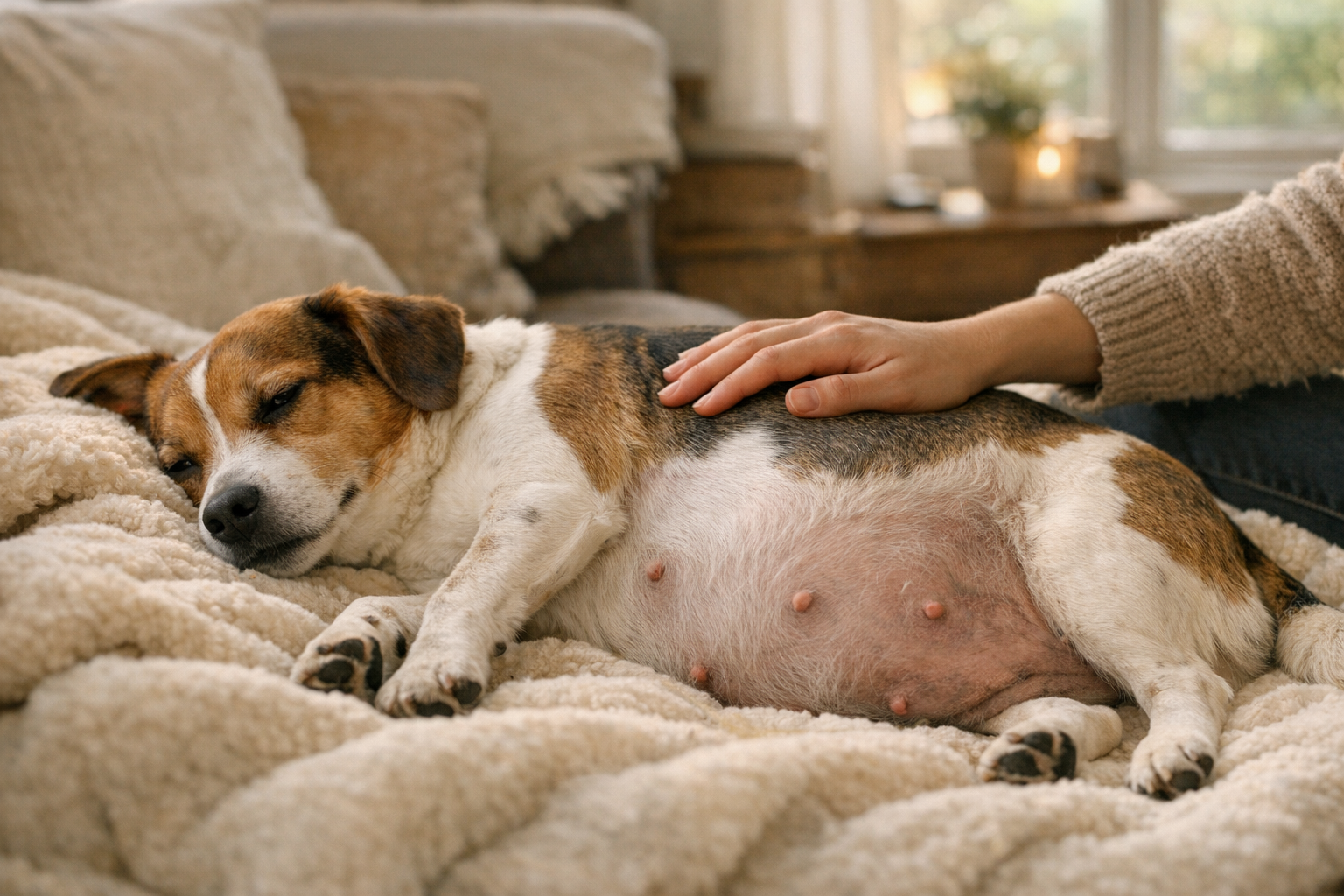
Now many dogs begin to show. The abdomen enlarges, weight goes up, and the mammary glands become more noticeable.
This is also when owners sometimes overfeed. Resist that urge. You want steady, appropriate weight gain, not a huge jump from extra snacks.
Weeks 7 to 9
The final stretch is obvious in most dogs.
She may have a larger belly, spend more time resting, and start nesting. Puppies can sometimes be felt or seen moving late in pregnancy. Her appetite may increase, then dip close to labor.
Some dogs become restless and start scratching at bedding, corners, or even outside spots. If that turns into determined nest-building or digging behavior, it can be part instinct, part stress, and part preparation for whelping.
Signs your dog may be pregnant
Pregnancy can only be confirmed by a vet, but owners often notice the same handful of clues.
Common signs include:
- enlarged or darker nipples
- increased appetite later in pregnancy
- mild appetite loss early on
- lower energy
- weight gain
- enlarged abdomen
- nesting behavior
- clinginess or mood changes
None of these signs is perfect on its own. False pregnancy can look surprisingly real. I have seen owners fully convinced their dog was pregnant, only to find out hormones were causing the changes without any puppies involved.
How vets confirm pregnancy
If you think your dog is pregnant, book a vet visit rather than guessing.
Ultrasound can often confirm pregnancy around day 25. Blood tests for relaxin can help after a similar point. X-rays later, usually after day 45, can show fetal skeletons and give a better estimate of litter size.
That last part matters more than people think. Knowing whether your dog is carrying one puppy or many can change how closely labor needs to be watched.
What to feed a pregnant dog
Food matters, but this is not the time for random diet experiments.
Most dogs do not need a huge calorie increase in the first half of pregnancy. In the second half, energy needs rise more clearly, especially with larger litters. Many vets recommend a high-quality puppy or growth formula later in pregnancy because it is more calorie-dense and balanced for the demands of fetal growth and nursing.
If you are unsure whether your current food is good enough, this Kirkland food review can help you think through quality basics, though your vet should still guide diet changes during pregnancy.
Keep treats sensible. A pregnant dog does not need lots of table food just because she looks hungry. If you are wondering about snack safety, read this guide on dogs and popcorn before tossing any from movie night.
Fresh water should always be available.
Exercise, grooming, and daily care
Most pregnant dogs still benefit from regular walks. Just keep them moderate.
This is not the moment for intense fetch sessions, rough play at the dog park, or forced exercise in hot weather. Think steady movement, not athletic conditioning.
Basic maintenance still matters too. Keep her clean, comfortable, and able to move well. If her nails are getting long, stay on top of nail trims so she has good footing as her weight shifts.
Avoid giving medications, supplements, flea products, or dewormers unless your vet says they are safe in pregnancy. Plenty of products are fine, but this is not a good time to assume.
Normal behavior changes during pregnancy
Pregnant dogs can act a little different, and not all changes are a problem.
Some become more affectionate. Some want space. Some start carrying blankets around or choosing odd sleeping spots. A few get irritable with other pets.
That said, behavior changes should still make sense in context. If your dog seems distressed, painful, collapses, refuses food for more than a day, or suddenly acts very unwell, call your vet.
When to call the vet during pregnancy
A pregnant dog does not need emergency care for every odd moment, but some signs should move you quickly.
Call your vet right away if you notice:
- bloody discharge before labor starts
- green or foul-smelling discharge before the first puppy
- repeated vomiting
- fever
- collapse or marked weakness
- severe abdominal pain
- no appetite for more than 24 hours
- hard straining with no puppy produced
- pregnancy going well past the expected window
Breathing deserves special attention. Mild panting late in pregnancy can be normal, especially when she is uncomfortable or close to labor. But obvious labored breathing at rest is different. If you are not sure what crosses the line, this article on heavy breathing while resting is worth a look, then follow up with your vet if anything seems off.
How to prepare for labor
Do this before the final week if possible.
Set up a quiet whelping area in a warm, low-traffic part of the house. Use washable bedding. Make sure she can get in and out easily, but puppies cannot wander off once they arrive.
Have your vet's daytime number and after-hours emergency number saved. Do not wait until 2 a.m. to search for them.
Useful supplies include:
- clean towels
- fresh bedding
- a heating source used carefully and safely
- a scale for weighing puppies
- your vet's contact information
- a notebook or phone notes for timing contractions and births
If your dog is due soon, start taking her temperature once or twice daily if your vet recommends it. A drop in rectal temperature often happens within about 24 hours of labor, though it is not foolproof.
What labor usually looks like
Labor has stages, and knowing the broad outline helps a lot.
Stage one often includes restlessness, panting, nesting, trembling, and refusing food. This can last several hours and sometimes up to a day.
Stage two is active labor and puppy delivery. Once hard contractions begin, the first puppy should usually arrive within a few hours. After that, puppies may come fairly quickly or with resting periods in between.
Stage three involves passing the placentas. Sometimes this alternates with puppy delivery.
Call your vet urgently if your dog strains hard for 20 to 30 minutes with no puppy, or if more than 2 hours pass between puppies when you know there are more to come and she is still in active labor.
How long after pregnancy can problems still happen?
The risk does not end once the puppies are born.
Mother dogs can develop mastitis, uterine infection, eclampsia, or severe exhaustion after whelping. Puppies can chill, fail to nurse, or fade fast. The first days are busy and sometimes nerve-racking, even when birth itself went smoothly.
If the mother seems disoriented, weak, feverish, uninterested in the puppies, or painful, call your vet the same day.
Common questions owners ask
Can a dog go past 63 days and still be normal?
Yes, especially if you are counting from breeding rather than ovulation. But if you are approaching day 68 from the last mating and there are no signs of labor, your vet should be involved.
Do first-time mothers stay pregnant longer?
Not in any reliable way. First-time moms may have clumsier labor or make owners more nervous, but the pregnancy length itself is usually not dramatically different.
Can you feel puppies moving?
Sometimes, late in pregnancy. It depends on the dog's size, litter size, coat, body condition, and how relaxed she is.
Is it okay for a pregnant dog to jump on furniture?
Usually it is better to limit repeated jumping late in pregnancy, especially for small dogs, heavy dogs, or dogs with orthopedic issues. Normal movement is good. Repetitive strain is not.
The bottom line
If you have been asking how long is a dog pregnant for, the best practical answer is about 63 days, with a normal range of roughly 58 to 68 days depending on timing.
Most pregnancies are straightforward. Some are not. That is why a vet-confirmed pregnancy, a sensible feeding plan, and a clear idea of labor red flags matter so much.
If your dog might be pregnant, get her checked, mark the likely timeline, and prepare early. It is a lot easier to stay calm when you are not trying to figure everything out once contractions start.